Sky ceiling light vs star projector: two different products
These get shopped for interchangeably because both promise "stars on the ceiling", and the listing photos for each look remarkably similar. The products are not similar. One is a fixed panel you install once; the other is a projector you place and move. Buying the wrong one for what you actually wanted is the most common disappointment in this category.
The difference in one paragraph
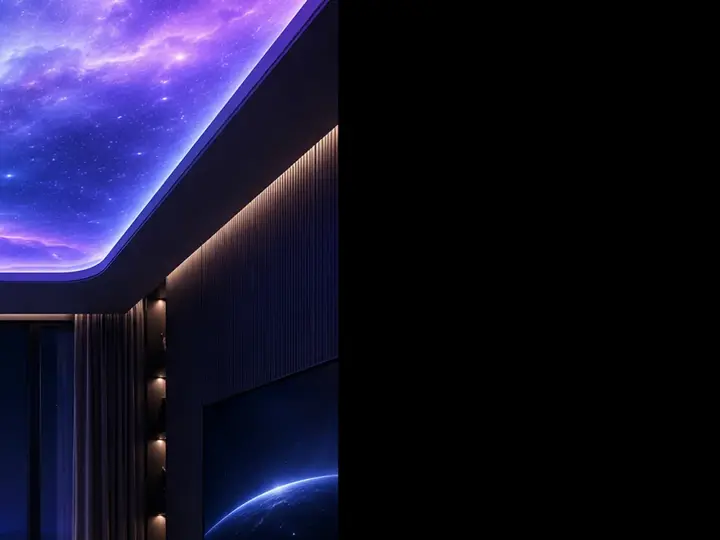
A sky ceiling light is a panel with a star or galaxy pattern printed, etched or cut into a translucent material, lit from behind by an LED strip. The stars do not move — the pattern is fixed in the panel — but the LEDs behind it can change colour and fade in intensity, which is what produces the twinkling. A star projector is a small unit, usually sat on a shelf or table, that casts moving points of coloured light onto whatever surface is in front of it — the ceiling, the walls, both — using a rotating lens or a moving laser element. The pattern genuinely moves and can cover a changing area of the room. Nothing about a sky ceiling light moves except the colour and brightness of the backlight; nothing about a star projector is installed.
What that means for coverage
| Sky ceiling light | Star projector | |
|---|---|---|
| Coverage | Fixed at install — exactly the size and position of the panel you fit. Cannot be changed without altering the ceiling. | Changes with distance and angle from the unit, and with the room — same unit covers a small area close to a wall or a whole ceiling from further back. |
| Installation | A ceiling job — flush-mounted or recessed into a coving edge, planned before or during ceiling work. Not something you move afterward. | None. Set it on a surface, point it, plug it in. Relocate it in seconds. |
| The "stars" | A fixed pattern baked into the panel. Every install of the same panel shows the same star positions. | Points of light in motion, and often a moving nebula-style wash alongside them, from a rotating optic. |
| Best for | A room where you want a permanent, always-there ceiling feature — a bedroom ceiling, a false-ceiling coving detail. | A room where the light needs to move, be turned off completely, or work in a rental where you cannot alter the ceiling. |
Why both look better in the listing photo than in your room
The reason is different for each, which is why understanding it helps with one but not the other.
Star projector photos are shot at a long exposure, which turns a moving point of light into a bright continuous trail — the swirling nebula effect in most listing photos is largely a camera artefact of tracking a moving laser over several seconds. Your eye does not integrate light over time the way a sensor does, so the live effect is softer and more obviously made of individual moving points rather than a continuous wash. This is the same exposure gap covered in star projector coverage and speed.
Sky ceiling light photos have a different gap: the panels shown are often larger, denser with "stars", or in a darker room than most home installs achieve, and the backlight is shown at a saturated colour that a real bedroom ceiling — usually left on low and warm for actually sleeping under it — will not run at continuously. The twinkle effect itself is real and does not disappoint the way the projector's exposure trick does; the gap is scale and room darkness, not the effect itself.
Running cost and what actually wears out
A sky ceiling light's only moving part is the change in colour and brightness of the LED backlight — there is no motor, no lens, nothing mechanical to wear. Standard LED backlighting has a rated life typically in the tens of thousands of hours before it dims meaningfully, which at a few hours a night, most nights, works out to well over a decade of ordinary use. Failure modes are almost always electrical — a driver or connection issue — rather than the light source simply wearing out the way an incandescent or halogen bulb would.
A star projector has a motor turning the optic that produces the moving points of light, and a motor is the one part in either product with a genuine mechanical wear life. It is a small, low-load motor and most units run for years without issue, but it is the part worth checking first if a projector's movement becomes jerky or stops entirely while the light output itself still works — that symptom points at the motor or its drive mechanism, not at the LED behind it. Dust on the lens is the other maintenance item unique to a projector; a sky ceiling light has no exposed optic for dust to settle on, since the panel itself is the visible surface.
Power draw is modest for both and is not usually the deciding factor between them — a panel backlight and a small projector motor plus LED are both low-wattage compared to general room lighting, and the practical difference in your electricity bill between the two is not large enough to be worth optimising for on its own.
Installing a sky ceiling light
This is a ceiling fixture, not a plug-and-place item, and it is worth planning before any ceiling work starts rather than after:
- Decide flush or coving-recessed before boarding the ceiling. A flush panel needs a frame built into the ceiling structure; a coving-edge installation hides the panel and its backlight behind a perimeter detail and is the easier retrofit into an existing ceiling.
- Size the panel to the room, not to the biggest one available. A panel that covers the full ceiling of a small room reads as a feature; the same panel in a large room reads as a small patch in the middle of a plain ceiling.
- Route the backlight cable before the panel goes up. Unlike a projector, there is no getting back in to reroute a cable once the panel and any surrounding ceiling finish are fitted.
Room darkness changes both products more than the spec sheet suggests
Neither product is designed to compete with ambient light, and how dark the room actually gets matters more to the final effect than any brightness setting in the app. A star projector's points of light are small and relatively dim by design — that is what makes them read as stars rather than spotlights — and even modest light from a hallway, a streetlight through a gap in the curtains, or a phone screen face-up on a nightstand will wash out the dimmer points long before it affects general room lighting. A sky ceiling light is more tolerant of some ambient light because the backlit panel is a larger, more diffuse source, but the twinkle effect specifically — the fade in and out of individual points — is still far more visible in a genuinely dark room than in one with any residual glow. If you are installing either product in a room that never gets fully dark, such as a child's room with a hallway light left on, set expectations accordingly before you buy: the effect will be visibly softer than the listing photos, for reasons that have nothing to do with the product's quality.
Common questions
Can I add more stars to a sky ceiling light later?
No — the pattern is fixed in the panel at manufacture. If you want the pattern to change or grow, that is what a projector is for, used alongside a fixed panel rather than instead of it.
Can I use both in the same room?
Yes, and it is a common pairing — a fixed panel for a permanent ceiling feature, plus a projector for a moving effect on the walls or the rest of the ceiling. They do not compete for the same job.
Which one is brighter?
Not a meaningful comparison — a sky ceiling light illuminates its own panel area evenly; a projector casts a small number of bright points across a larger, changing area. Neither is designed to light the room.
Which app runs a sky ceiling light?
Lotus Lantern. Full mapping here.
Will either one damage a child's sleep if left running all night?
Set to a very low, warm, non-changing setting, most families find either acceptable as a night-light replacement. A projector's moving points are more stimulating than a steady glow and are usually better switched off once a child is asleep rather than left running all night; a sky ceiling light held at a low steady level is closer to a conventional night-light in effect.
Which one is easier to take with you if you move house?
The projector, without question — it is a plug-in unit with no installation to undo. A sky ceiling light is built into the ceiling and is not something you take with you; budget for that when choosing between them in a rented property.
Contact us if you are not sure which of the two actually fits what you have in mind before you buy either.