How many Christmas lights does a tree need?
Every guide answers this in bulbs — 400 for a six-foot tree, 100 per foot, pick a number. It is the wrong unit. Two strings with the same bulb count can differ in length by three times over, and length is what has to reach round the tree.
Key takeaways
- Multiply bulb count by bulb spacing. The lit length is the only number that has to reach round the tree.
- A 1.8 m tree takes about 16 m spiral-wrapped, or 40–48 m branch by branch.
- Buy that length as several 10–20 m strings, not one long one.
- Never chain past the limit printed on the string: the far end dims first, then the input connector runs warm.
- Everything dark after one point is a data-chain break at the last lit bulb; scattered dead bulbs are harmless.

Why bulb counts mislead
A light string has two numbers that matter: how many bulbs, and how far apart they sit. Multiply them and you get the only figure that helps you, which is the lit length of the string.
Across the strings we build, bulb spacing runs from roughly 5 cm on dense decorative strings up to 15 cm or more on long garden strings. So a 200-bulb string is anywhere from 10 m to 30 m long. Bulb count alone is not enough to determine the length, which is why so many people end up either short by a third or with 8 m of string left in the box.
Find the spacing first. It is usually on the box as "bulb spacing", "LED pitch" or "spacing between lights". If it is missing, divide the stated total length by the bulb count. If neither length nor spacing is stated, that tells you something about the product.
The arithmetic that actually works
How much string a tree takes depends far more on how you wrap it than on how tall it is. There are two methods, and they differ by roughly three times. Almost all the confusion about tree light quantities comes from guides quoting one number without saying which method it assumes.
Method A — spiral wrap around the outside
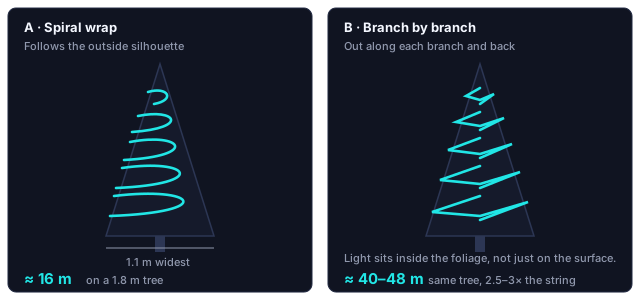
You spiral the string around the outside of the tree, following its silhouette. Fast, and the effect is a lit outline.
Measure the tree height h and its widest diameter d,
both in metres. A tree is roughly a cone, so its average diameter is about half its widest,
and one turn around it is about π × d ÷ 2. Pick a vertical gap between turns —
20 cm gives a full look, 30 cm is sparser:
Length = (h ÷ gap) × (π × d ÷ 2)
A 1.8 m tree, 1.1 m across, wrapped at a 20 cm gap: 9 turns × 1.73 m ≈ 16 m of string.
Method B — branch by branch
You run the string out along each branch and back toward the trunk, so the light sits inside the foliage as well as on the surface. This is what makes a tree look lit from within rather than wrapped in a band, and it is what most people actually want when they say a tree looks "professionally done".
It also consumes far more string. Take your Method A figure and multiply by 2.5 to 3. The same 1.8 m tree needs 40 to 48 m.
| Tree height | Spiral wrap | Branch by branch |
|---|---|---|
| 1.2 m (4 ft) | ~8 m | ~20–24 m |
| 1.5 m (5 ft) | ~12 m | ~30–36 m |
| 1.8 m (6 ft) | ~16 m | ~40–48 m |
| 2.1 m (7 ft) | ~22 m | ~55–66 m |
| 2.4 m (8 ft) | ~28 m | ~70–84 m |
These assume a normally proportioned tree at a 20 cm wrap gap. A slim or pencil tree needs less; a wide farm-grown tree needs more. Measure your own diameter rather than trusting the row.
When the listing only gives a bulb count
Plenty of listings still quote bulbs and nothing else. If that is all you have, this is the translation at the 6 to 7 cm spacing most tree strings use, and the look each row produces. Check it against the table above: the bulb counts listings recommend are sized for a spiral wrap with a fuller look, and fall well short of branch by branch.
| Tree height | Bulbs quoted | Length it implies | The look |
|---|---|---|---|
| 1.2 m (4 ft) | 150–200 | 10–15 m | Warm and simple |
| 1.5 m (5 ft) | 250–350 | 15–25 m | Standard density |
| 1.8 m (6 ft) | 400–600 | 25–40 m | Dense, a fuller look |
| 2.1 m and up (7 ft+) | 700 and up | 40 m and up | Full, starry cover |
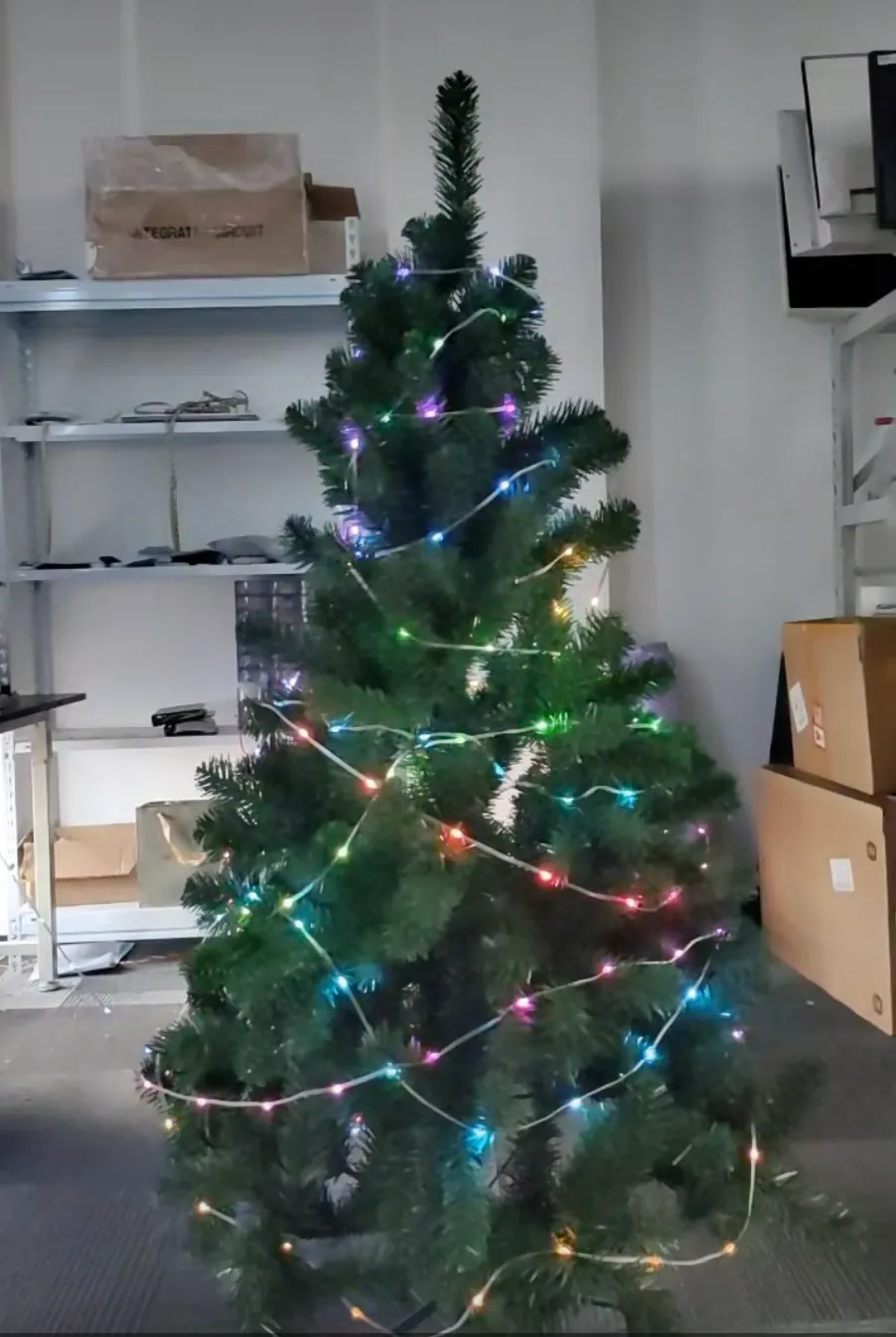
Putting the string on so the tree is lit from within
The branch-by-branch figure above only pays off if the string actually goes into the tree. The method below produces a tree that glows from inside rather than one wearing a band of light, and it is the same method whether the tree is 1.2 m or 2.4 m.
- Test every string first. Fully unrolled on the floor and plugged in. A dead section or a loose joint found now costs a minute. Found after wrapping, it costs the whole wrap.
- Start at the top, and decide where the plug ends up. Fix the end without the plug near the top of the trunk and work down, so the plug end arrives at the base next to the socket. If several strings connect end to end, the per-chain limit below still applies.
- Go in and out along each branch, not around the outside. At every main branch, run the string from the trunk out to the tip and back to the trunk, then move to the next branch. This is the step that puts light in the depth of the tree, and it is what the Method B allowance is spent on.
- Work down in layers. Around the tree in a zigzag or a steady clockwise band, one layer at a time, keeping the bulb density the same on every side and at every height. The commonest failure is a dense top and a sparse base, because the string ran out halfway.
- Hide the wire, then look from across the room. Push the green wire into the needles wherever it shows. Then turn the room lights off and look from two or three metres: gaps and hot spots show at that distance and not from arm's length.
Ornaments go on after the lights and never before. The order for everything that follows is in decorating the tree in layers.
The part nobody tells you: how many strings, not how much string
Length gets you to the shop. What decides whether the install works is how you split that length across separate strings — and this is where our own returns and support questions concentrate.
Take the 1.8 m tree needing 45 m branch-wrapped. That can be one 45 m string or three 15 m strings. The three shorter strings are almost always the better buy:
- One dead string is not one dead tree. On a single long run, any fault takes the whole tree out. Split across three, you lose a third and the tree is still usable while you sort it out.
- You can wrap in sections. Bottom third, middle, top. Far easier alone, and much easier to fix a patch that looks thin without unwinding everything.
- Packing away is survivable. A 45 m string tangles into a single knot that takes an evening. Three 15 m strings do not.
- Long runs dim toward the far end. The further from the supply, the more voltage the conductors have already dropped. On a short string it is invisible; near the maximum length for that design, the tail is measurably duller than the head.
Do not chain strings past the stated limit. Every connectable string has a maximum number of units that can run end to end — it is printed on the string or in the leaflet. That limit is set by the current the first connector and the thinnest conductor carry, not by the controller running out of addresses. Exceeding it dims the far end first, then runs the input connector warm. This is one of very few rules in decorative lighting we would call a hard limit.
Warm white, cool white, or colour?
Warm white sits around 2700K and reads as candlelight against green foliage. Cool white above 5000K reads blue-ish and, on an artificial tree, tends to reveal the plastic. If you are mixing colour and white on the same tree, put the white string on first and the colour over it — reverse it and the colour disappears into the interior.
Scan the QR code on the box to get the matching app. Install it and check it controls the string before you start wrapping — on some models pairing is easier with the string still in the box. Not sure which one? See which app controls your light.
Half the string went dark — what that tells you
This is the single most common festive-season question we get, and the answer depends on how the string is built. The pattern of the failure identifies the type.
Everything after one point is dark, everything before it is fine
A clean split like this means the string is a chain and the chain is broken at that point. On an addressable string, each bulb passes the data signal to the next; if one stops passing it, every bulb downstream has power but no instruction, so it stays off. The last lit bulb is your marker — the fault is at it or in the joint immediately after.
Scattered bulbs out, no pattern
Individual bulbs failing independently means they are wired in parallel, which is what we use on most modern LED strings precisely so that one failure does not cascade. Annoying to look at, harmless electrically, and it does not spread.
A whole section flickers together
Sections flickering as a group point at the connection feeding that section rather than at any bulb. Most often it is a plug that is seated but not fully home, or a joint that has taken water in an outdoor install.
The string works until you move it
Intermittent-when-flexed is a conductor problem inside the sleeve, usually within 30 cm of a plug where the wire has been bent repeatedly across seasons. It will get worse. Note where it is when you pack up, so you are not diagnosing it again next December.
We do not cover repair here — cutting into a sealed festive string rarely pays and voids whatever warranty it has. What matters at this stage is knowing whether you have a data-chain break, a parallel bulb failure or a connection fault, because that decides whether to keep the string.
Switch the tree off at the plug, or put it on a timer. An older incandescent string runs warm enough to matter against paper and thin plastic decorations, so keep those clear of the bulbs. If you are buying new, buy a low-voltage LED string, 12 V or 24 V through a plug-in supply: it runs cool, and nothing inside the tree is at mains voltage.
Packing them away so they work next year
Most strings that fail in December failed in January. Three things account for nearly all of it:
- Wind onto something, never into a ball. A length of stiff card or a reel. Balled string gets untangled by pulling, and pulling is what breaks conductors at the plugs.
- Store the controller box padded and dry. The controller and battery box are the parts that do not tolerate a damp loft or a cold garage across a whole year. Inside the house is better, even if the tree lives in the garage.
- Take the batteries out. On battery-powered strings this is the one that ruins hardware outright. A cell left in for eleven months can leak and corrode the contacts beyond recovery.
Alternative: the structured cone tree light (centre-pole / ring light tree)
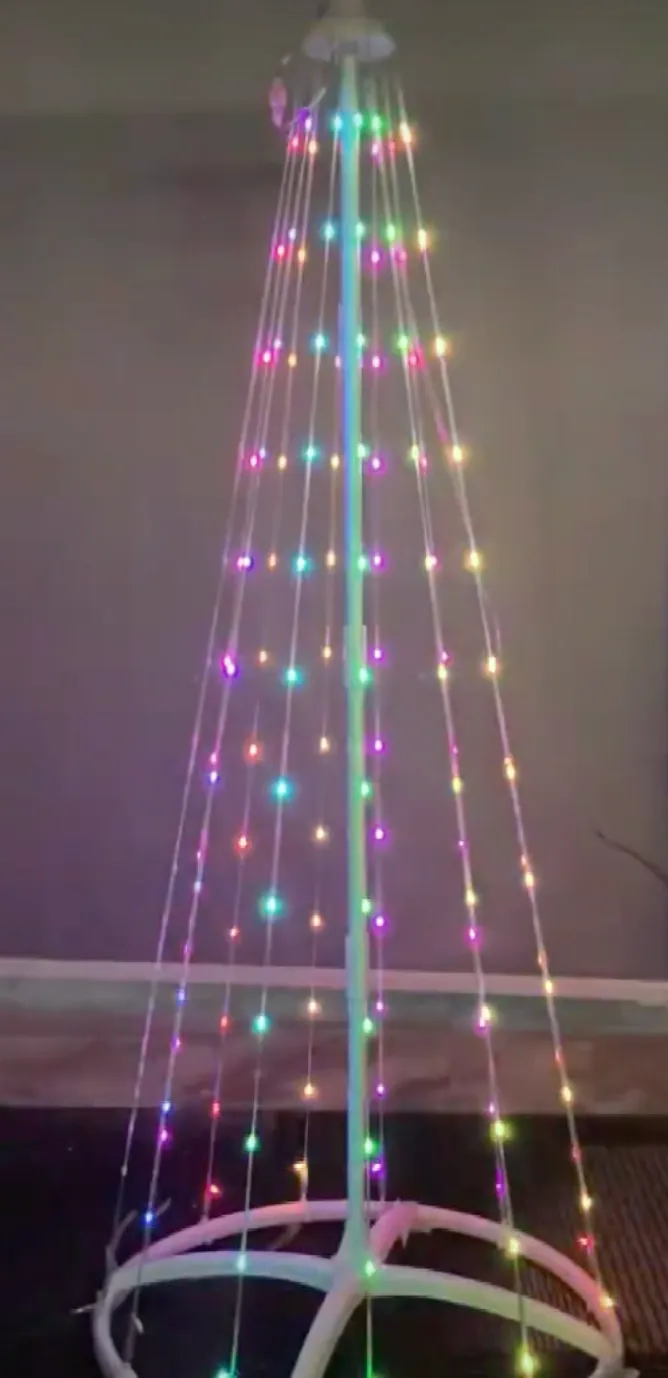
Compared with wrapping a real tree, a structured tree light is a faster deployment. A single suspension point at the top and a ring spreading the base put the strands under tension, and that tension alone forms a regular geometric cone. Strand pitch is fixed by the frame, so LED distribution is set by geometry rather than by how evenly the string was wound. The design removes uneven coverage at the structural level and reduces installation to hanging the top and setting the ring.
| Criterion | Wrapping a real tree | Structured cone tree light |
|---|---|---|
| Installation effort | Measured in metres and wound in sections; branch by branch, a 1.8 m tree takes 40–48 m of string and hours of work | Hang the top, set the ring; no measuring, no winding |
| Uniformity of light | Depends on technique; a dense top and a sparse base is the common result | Fixed by geometry and strand pitch; equal spacing on every strand |
| Appearance | LEDs sit inside the foliage and light it from within, so the light is seen and the source is not | A complete cone across a room; the linear strands are visible within a metre |
| Prerequisites | A tree | A load-bearing suspension point and floor space for the ring |
Where the tree itself is the visual focus rather than a carrier for ornaments, in a shop window, a stairwell or an entrance hall, the structured light is the more efficient choice. A living-room tree that needs ornament layers and light from within remains the case for wrapping.
How the metre rule applies to the mainstream smart strings
Spacing times bulb count equals length, whichever brand is on the box. What changes is whether the maker prints the spacing.
| String | Bulbs | Lit length | Spacing | On a 1.8 m tree |
|---|---|---|---|---|
| Twinkly Strings (Gen II) | 250 / 400 / 600 | 20 m / 32 m / 48 m | 8 cm, printed | The 250 covers a spiral wrap (about 16 m); branch by branch (40–48 m) needs the 600 |
| Philips Hue Festavia (2nd gen) | 100 / 250 / 500 | 8 m / 20 m / 40 m | About 8 cm, worked out as 40 m ÷ 500 | Same answer; the 40 m version is two 250-bulb strings joined at a box, and its colour gradient runs across three points on the string rather than per bulb |
| Govee Christmas String Lights 2 (RGBWIC) | 200 | 20 m (66 ft) | Not printed; 20 m ÷ 200 is about 10 cm | One string spiral-wraps the tree; branch by branch needs two or three |
Twinkly's and Govee's newer strings also use the phone camera to map where each bulb ended up on the tree, so that effects can be drawn across it in two or three dimensions. Ours run effects along the chain order and need no mapping step.
Sources: Twinkly Strings; Philips Hue Festavia; Govee Christmas String Lights 2.
Still deciding what to buy?
Work out your length with Method A or B, divide it into runs of 10–20 m, check the per-chain limit on the packaging, and confirm the spacing is stated at all. That is the whole job. If you want the tree to also run effects rather than sit on one colour, check the control app first — the app has to match the controller, and a festive string is the product line where people most often download the wrong one.
Questions about a specific string of ours? Contact us.