G01: broadcast control — one remote, many lights
Twelve lawn lights across a garden, eight downlights in one ceiling, a line of spotlights along a fence: fixtures installed as a set and expected to behave as one. G01 is the fixed-colour RGB platform for that case. Each fixture listens on 2.4 GHz for connectionless broadcast commands, so one press on the remote or one instruction from the app reaches every paired fixture within range at the same instant, with no hub between them.
Key takeaways
- One transmitter reaches every paired fixture in range at once; nothing replies, so set size adds no delay.
- Design coverage is a 20 m radius in open air; each 6 dB of wall loss halves it, and fixtures do not relay.
- A radio remote needs no infrared window: the enclosure can be sealed and the board hidden anywhere inside.
- Dynamic modes start in step and drift on each fixture's own clock; resending the mode re-aligns the set.
- A fixture that stops following is at the edge of range or lost its pairing after a power interruption.
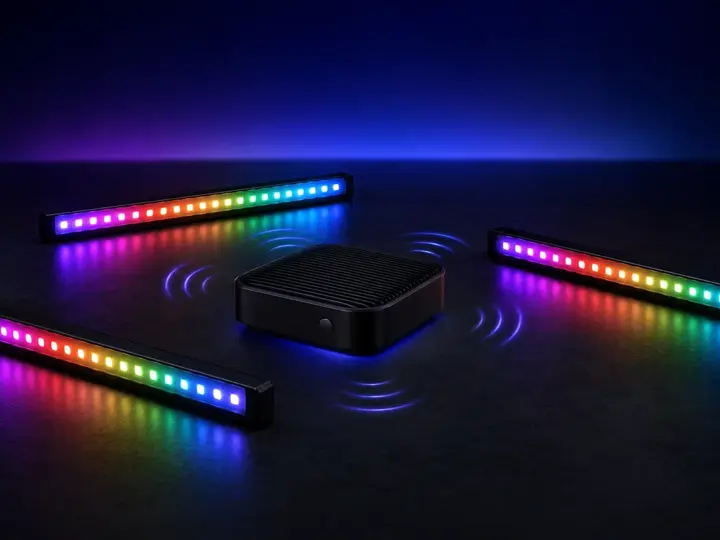
What "broadcast" means here
A conventional Bluetooth light is a connection-oriented, point-to-point arrangement: the phone establishes a link with one fixture, sends a command over it and receives an acknowledgement. The phone or hub at the central end supports a limited number of links at once — around twenty is typical. Broadcast control removes the link. Bluetooth LE and the proprietary 2.4 GHz protocols on the same radio carry connectionless advertising transmissions that any number of receivers may pick up simultaneously. The G01 remote or app transmits a command into the air; every fixture within range that is paired to that transmitter applies it on receipt, without answering back.
| Dimension | Point-to-point Bluetooth | Hub or gateway | G01 broadcast |
|---|---|---|---|
| Installation efficiency | Each fixture paired to the phone in turn | Hub commissioned first, each fixture then joined to it | Each fixture paired once to the transmitter; the others untouched |
| Response consistency | Commands sent link by link; fixtures change in sequence | Hub forwards to each fixture; delay grows with count | One transmission, applied by every fixture on receipt |
| Scaling limit | The central's connection count, around twenty | Hub capacity and network load | Radio reach from the transmitter; count adds no traffic |
| Infrastructure | Phone within range of each fixture | Hub, mains, usually Wi-Fi and an account | Transmitter and fixtures only; no network, no account |
A hundred fixtures follow one command exactly as one fixture does, and adding a fixture means installing and pairing it, not touching the others.
Range and coverage
The design figure is a 20 m radius from the transmitter, roughly 400 m² in open air: a typical garden, a large room or one side of a building.
Two qualifications apply. First, it is an open-air figure. Radio range follows an inverse-square law, so every 6 dB of additional loss halves the distance. At 2.4 GHz a plasterboard partition costs about 3–5 dB, a brick wall 4–6 dB and a heavy concrete wall around 20 dB: one brick wall between remote and lawn takes 20 m to roughly 10 m, and a reinforced concrete wall reduces it to a few metres. Second, the radius is measured from the transmitter, not between fixtures. Fixtures do not relay: a fixture 30 m from the remote is not reached by way of one 15 m away. A long run is controlled from its midpoint, or the far group is paired to a second transmitter.
No receiver window
The G01 remote is radio, not infrared, and that decides the fixture's enclosure. An infrared receiver sits behind a transparent window with line of sight to the seating position; a 2.4 GHz receiver needs no aperture, so the housing can be sealed and the board placed anywhere inside. For a lawn light sealed against rain, or a downlight recessed into a ceiling, that is a requirement rather than a convenience.
| Dimension | Infrared remote | 2.4 GHz radio remote |
|---|---|---|
| Enclosure | Window moulded into the housing; limits sealing and concealment | No aperture; housing sealed, board hidden anywhere inside |
| Reach | 3–10 m with clear line of sight | 20 m design radius in open air; through partitions with the losses above |
| Set control | One fixture per press, the one in the beam | Every paired fixture in range per press |
| Cost per fixture | Receiver module plus window tooling | About that of an infrared receiver, below 433 MHz, no window tooling |
Single chip, few parts
G01 is a single-chip design in a SOP16 package — large-pitch pins that are placed by machine and reworked by hand — with very few external components. The board is small enough for a ground stake, a downlight can or a spotlight body; and when one fixture in a set of twenty fails, the board is one a technician can inspect and repair rather than replace.
Modes
| Kind | Count | What they do |
|---|---|---|
| Static | 7 | A fixed colour or white across the set |
| Dynamic | 22 | Fades, jumps, breathing and strobes, with adjustable speed, applied identically to every fixture |
| Music | 4 | Sound-reactive modes driven by a microphone on the fixture |
A dynamic mode is a sequence, and a broadcast command starts it on every fixture at the moment of receipt, so the set begins in step. From then on each fixture runs on its own clock. A microcontroller timed from an internal RC oscillator typically holds ±1.5 %; two fixtures at opposite limits separate by up to 1.8 s per minute, and a breathing cycle of a few seconds is visibly out of phase within minutes. A crystal-timed fixture, at ±10 ppm, drifts about 1.2 ms per minute. Resending the mode re-aligns the set. Products that must stay locked indefinitely — a row of car ambient lights — are built on the master–slave platform, where every slave displays the master's state on one clock.
Three control paths
- The app, over Bluetooth: colour, brightness, colour temperature, mode selection, music sync and timers, in the Lotus Lantern app.
- The 2.4 GHz remote, reaching every paired fixture in range at once. It is built on a dedicated 2.4 GHz transmitter chip or a Bluetooth LE SoC, has short press, long press and a sleep state, and can be assigned to a single light, a group or a zone.
- Buttons on the fixture: on/off, brightness and mode when neither remote nor phone is to hand.
What it is built for
The platform belongs in any light bought and installed in multiples: lawn and path lights, recessed downlights, spotlights, night lights, sensor-triggered lights and star ceiling lights. The common requirement is group control without a hub. It is not the platform for a single strip behind a desk — the Y96 platform covers that with a wider choice of remotes — nor for effects that travel along a run, which is Y16.
What a product on G01 can be customised to do
For a fixture specification: the function of each remote button can be set or changed, as can the on-board button behaviour for switching, brightness and mode, and the app can be white-labelled. The mode set belongs to the platform; the remote layout belongs to the product.
Mistakes we see most often
One fixture in the set stopped following
Either it sits at the edge of range — typically the one behind the garage — or it lost its pairing after a power interruption. Check range first by carrying the remote to it; re-pair second.
The set works from the garden but not from indoors
Wall loss: a brick wall halves the open-air 20 m, a concrete wall cuts it to a few metres. Control the set from a point with fewer walls in the path, or pair the hardest-to-reach fixtures to a second transmitter.
The fixtures have drifted out of step
Expected after a long run in a dynamic mode; each fixture keeps its own clock. Resend the mode to re-align them. Strict, permanent sync is a master–slave job.
The remote does nothing at all
With no infrared window there is no line-of-sight fault to look for. Check the remote's battery, then pairing. A remote never paired to these fixtures reaches none of them, by design.
Common questions
Will my remote change my neighbour's lights?
No. A fixture responds only to a transmitter it has been paired with. Two households next door with the same product are two separate sets.
Can I control part of the set separately?
Fixtures follow the transmitter they are paired to. To control two groups independently, pair them to two transmitters.
Which app runs it?
Lotus Lantern. Full mapping here.
Sources: Bluetooth SIG LE Primer; Nordic Developer Academy; iBwave; WiFi Weave; noIM₃; Fraunhofer; SYSTO.
Contact us if you are specifying a set of fixtures on this platform and need a further detail.