Dual-white strip: 2-wire vs 3-wire, and which one dims cleanly
A bedroom run dimmed to 5% as a night light drifts away from the warm white you set, while the same reel in the kitchen at full brightness looks exactly right. Tunable-white LED strip is sold in two wiring schemes that look identical on the reel, and the difference between them shows at low brightness — which is where most people use it.
Key takeaways
- 2-wire strip alternates polarity so warm and cool take turns; 3-wire drives both at once on separate channels.
- Dim a 2-wire run to 10% and the colour can step or drift. 3-wire holds the ratio down to night-light levels.
- Reversed polarity on 2-wire lights the wrong white, not nothing. Check the connector before blaming the strip.
- Two reels with the same kelvin can differ side by side. Buy one wall's run from one batch.
- Match strip to controller. In Lotus Lantern the two schemes are separate device categories.
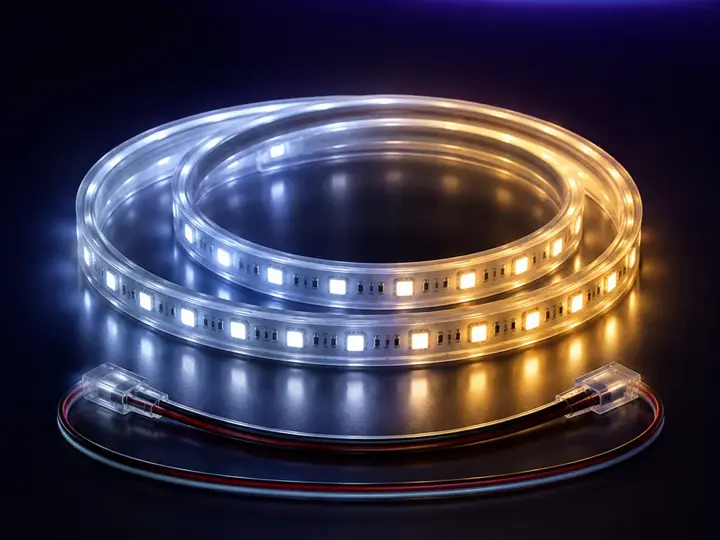
What a dual-white strip actually does
A dual-white strip carries two kinds of emitter alternating along its length: one warm, usually around 2700K, which reads like candlelight and flatters wood and skin; and one cool, usually around 6000K to 6500K, which reads blue-white against a warm room. No single emitter changes colour. What changes is the ratio — drive the warm emitters harder and the run reads warm, drive the cool ones harder and it reads cool, drive both and you land between. Your eye blends the two because the emitters sit close together and the strip is normally behind a diffuser or a channel lip.
That blending is the first limitation. Dual-white strip mixes properly at a distance; up close, under a clear cover, or on a strip with widely spaced emitters, you see individual warm and cool points rather than the mix. If the run will sit within arm's reach — a mirror surround, a bathroom shelf, a headboard — plan on a diffused channel from the start. Bare strip within a metre of the eye rarely blends, and moving it further from the surface it lights is the other fix.
How the two wiring schemes mix warm and cool
2-wire: polarity picks which emitter conducts
A 2-wire strip wires the warm and cool emitters antiparallel — facing opposite directions across the same pair of conductors. Feed it one polarity and only the warm emitters conduct; reverse it and only the cool ones do. LEDs are diodes, so each set blocks current in the direction it does not like.
To produce a mix, the controller alternates polarity rapidly and varies how much of each cycle it spends in each direction. Sixty percent of the time warm and forty cool gives a blend biased warm. The eye integrates the alternation into one steady colour, the same way it integrates any other pulse-width modulation.
The appeal is two conductors instead of three: thinner cable, cheaper connectors, simpler joints, no third wire to get wrong at a corner. On a long decorative run, in a profile with little room, or where a joint has to be made in an awkward place, that is a real advantage.
3-wire: two channels sharing a common rail
A 3-wire strip gives warm and cool their own conductor and shares the third as a common rail — usually common anode, so the shared wire is the positive supply and the controller switches each colour's negative independently. Two separate PWM channels, no polarity reversal, no interleaving. The controller can hold warm at 12% and cool at 3% indefinitely, because nothing about one channel constrains the other.
The cost is the extra conductor: bulkier cable, three-pin connectors, one more thing to align at every joint. On a short, accessible run that is nothing. On forty metres of eave with six corners it is not.
| 2-wire (antiparallel) | 3-wire (common anode) | |
|---|---|---|
| How it mixes | Alternating polarity; the two colours take turns | Two independent PWM channels; both on at once |
| Conductors | Two. Thinner cable, simpler joints | Three. Bulkier cable, one more conductor to align at every joint |
| Low-brightness behaviour | Colour can drift or step as the mix and the dim level interact | Holds a set colour down to low levels |
| Peak output | Roughly one colour's full output; full warm plus full cool at once is not available | Both channels at full together |
| Supply reversed | Lights the other white | Lights nothing |
| Lotus Lantern category | 2-Wire Dual-White Lighting | 3-Wire Dual-White Lighting |
| Best for | Decorative and mid-brightness runs, long or awkward routes, tight profiles | Task lighting, low-level and night use, anywhere the colour must stay put |
The two schemes are not interchangeable at the controller. A 3-wire controller never reverses polarity, so a 2-wire strip on it lights one colour only. A 2-wire controller on a 3-wire strip leaves one channel unconnected and reverses polarity on a strip with no path for it. That is why our Lotus Lantern app lists them as separate device categories: match the strip to the controller, then pick the matching category when you pair.
Why 3-wire holds its colour when dimmed
Both schemes dim the same way underneath: pulse-width modulation, switching the emitters fully on and fully off fast enough that you see an average rather than a flicker. Brightness is the fraction of each cycle spent on — the duty cycle.
On a 3-wire strip, colour and brightness are separate problems. Colour is the ratio between the two channels' duty cycles; brightness is their sum. Halve both and the ratio survives, so the colour survives the dim.
On a 2-wire strip they are one problem. There is one cycle to divide, and it has to encode warm time, cool time and off time at once. Dim to 10% and only a tenth of each cycle does any work; the warm and cool slices inside it are now very short. Controllers have finite timing resolution, so as those slices shrink, the number of distinct ratios the controller can produce shrinks with them. A blend that was smooth at full output becomes a handful of coarse steps near the bottom of the range, and the visible symptom is colour that shifts as you dim rather than staying where you set it.
Flicker, and the frequency that buys margin
The 2-wire scheme does more switching per unit of output, so flicker deserves a look. IEEE 1789-2015, the recommended practice for modulating current in high-brightness LEDs, sets two lines:
| Switching frequency | Low-risk limit | No-observable-effect limit |
|---|---|---|
| 90 to 1250 Hz | Modulation depth up to 0.08 × frequency | Up to 0.0333 × frequency |
| 1250 to 3000 Hz | No restriction | Up to 0.0333 × frequency |
| Above 3000 Hz | No restriction | No restriction |
PWM dimming switches fully on and fully off, which is 100% modulation depth. Run the arithmetic and the thresholds fall out: 0.08 × 1250 is 100, so a PWM controller at 1250 Hz or above clears the low-risk line at any dim level; 0.0333 × 3000 is 100, so 3000 Hz clears the stricter line too. Switching frequency is what buys margin, and a strip you intend to run dim, near a desk, or on camera is where that margin matters.
Cameras are the unforgiving case. Your eye integrates the waveform; a phone shooting at 1/1000 s samples a slice of it and catches individual on and off phases as bands or pulsing. A run that looks steady to the eye can band badly on video. Raising the switching frequency is the fix, and the thing to ask about before buying if the run will ever be filmed.
Why two reels with the same kelvin do not match
Warm and cool endpoints are quoted in kelvin, and the reasonable expectation is that two strips quoting the same number look the same. They often do not.
Correlated colour temperature collapses a point on the chromaticity diagram into one number. Two emitters can share a CCT and still sit visibly apart, one greener, one pinker. ANSI C78.377, the American standard for solid-state lighting chromaticity, handles this by defining nominal CCT targets each with a tolerance quadrangle around it — a region derived from seven-step MacAdam ellipses rather than a single point. The 2024 revision added 2000K and 1800K to the ten nominal values that ran from 2200K to 6500K, for outdoor and specialised indoor work. Two products can both sit inside the same quadrangle and still be told apart side by side.
- Buy a continuous run from one batch. Two reels of the same specification bought months apart can land in different parts of the same tolerance region. Joined end to end on one wall, the difference is visible; in separate rooms, nobody notices.
- Judge the mix, not the endpoints. The intermediate settings are what you live with, and they depend on the two emitters and the controller together.
- Check the mid setting before committing. Power a metre in the actual room, at the level you expect to use, before cutting and sticking forty.
Which scheme for which room
The question that decides it is not the room, it is the brightness you will actually use.
| Where | How it is used | Pick |
|---|---|---|
| Kitchen under-cabinet | Cool for prep, warm in the evening, dimmed both ways | 3-wire |
| Bathroom mirror surround | Close to the face; colour must stay even at low level | 3-wire |
| Bedroom night light | Parked at 5% for hours | 3-wire |
| Study or workbench | Dimmed a long way and still expected to look deliberate | 3-wire |
| Cove lighting | Long route; lives in the middle of its range | 2-wire |
| Shelf wash, display backdrop | Atmosphere, not task | 2-wire |
| Decorative perimeter with many corners | Thin cable and simple joints matter more than low-end precision | 2-wire |
| One run doing both jobs | Bright and neutral for cleaning, dim and warm for the evening | 3-wire |
The driver and switching side of an under-cabinet install is in the cabinet lighting guide. If maximum output at a neutral setting matters, that is another point for 3-wire: a 2-wire strip's peak is roughly one colour's full output, because the two sets take turns.
Is dual white the same as RGB set to white?
No, and the difference is colour rendering. White mixed from red, green and blue has gaps in its spectrum, so skin, wood and fabric look wrong under it. A dual-white strip uses actual white emitters — phosphor-converted, with a continuous spectrum — and renders those surfaces properly. For any run that lights something people look at closely, dual white is the right family. If you want colour for atmosphere and a real warm-to-cool white on the same strip, that is an RGBCCT strip with warm and cool white rails on a five-channel controller — see Y96: fixed-colour RGB control.
Wiring it: polarity and run length
Two things catch people out on dual-white specifically.
The first is polarity, and it inverts between the schemes. On a 3-wire strip, reversing the supply gives you nothing, which is annoying but obvious. On a 2-wire strip, reversing it gives you the other colour — a working light in the wrong white. A run that comes up warm when the controller says cool is usually a flipped connector, not a faulty strip, and it is a two-second fix once you know to look.
The second is voltage drop, which behaves as it does on any low-voltage strip: the far end of a long run gets less voltage and dims. On a dual-white run that can read as a colour shift as well, because the two emitter types do not fade at the same rate as the supply sags. The fix is the same — inject power at both ends or split the run — and the arithmetic is in the guide to strip length and power.
Decide by the lowest brightness you will use, not by the room. Power a metre in place at that level before cutting the run, buy the whole wall from one batch, and pair it under the matching Lotus Lantern category — the app mapping lists both.
Questions about a specific dual-white controller of ours? Contact us.