App guide
Lotus Lantern
Lotus Lantern is the Bluetooth app for our single-colour, tunable-white and 3-channel RGB controllers: lights on which every LED shows the same colour at the same time. It sets colour, colour temperature and brightness, runs preset effects, follows music or a microphone, and holds separate on and off schedules. The app is free.
Key takeaways
- Lotus Lantern covers 18 of our 40 product categories: 1-, 2- and 3-channel strips and most decorative strings, Christmas strings included.
- Each app speaks one controller protocol: a light built for LotusLamp X or Magic Lantern never appears in this device list.
- The App Store lists the app as LotusLanternX and Google Play as Lotus Lantern. Both are free, with no in-app purchases.
- Modify Pin Sequence, in the settings pop-up, corrects red-for-green colour swaps and is saved on the controller.
- Pair within a metre or two of the light. Most of our controllers hold one phone at a time.
Where to get the app
Install Lotus Lantern from Google Play on Android or from the App Store on iPhone and iPad. The App Store listing carries the title LotusLanternX and requires iOS 12 or later; the Google Play listing is titled Lotus Lantern. Both show the app as free, and Google Play lists no in-app purchases and no advertising. An app that asks for payment before it will control a light is not ours, whatever its name.
The store descriptions summarise the same functions as the interface sections that follow: colour, brightness and colour temperature of the strip, preset flash modes, rhythm from music or from a microphone, and control of several strips over Bluetooth. The controllers the app can drive are fixed by the protocol, not by the store.
Compatible lights and controllers
Lotus Lantern drives the controllers in the 18 product categories in the table, over Bluetooth Low Energy directly from the phone: no router, no account and no cloud step. The common factor is that every LED on an output shows one colour at a time. A strip on which colour travels along the run is addressable and belongs to Magic Lantern; a 4- or 5-channel full-colour strip belongs to LotusLamp X. A card, QR code or box that names an app overrides the table, and the complete 40-category map is in which app controls your light.
| Category | Control type | Notes |
|---|---|---|
| 1 Channel | 1 output, single-colour dimming | Mono white or warm-white strip |
| 2 Channel | 2 outputs, tunable white (CCT) | Warm-to-cool ratio on one strip |
| 3-Channel RGB | 3 outputs, red + green + blue | Whole strip one colour at a time |
| Single-Color Lighting | Single-colour output | Functional lighting |
| 2-Wire Dual-White Lighting | 2-wire dual white | Tunable white on two wires |
| 3-Wire Dual-White Lighting | 3-wire dual white | Stable dimming |
| 2-Wire Copper Light | 2-wire decorative string | Copper-wire string |
| 2-Wire 8-Mode Christmas Light | 2-wire string, 8 modes | Festive string |
| Christmas Tree Light | Festive string | Tree decoration; length is worked out in metres, not bulbs |
| Curtain Light — Wired | Wired curtain | Fixed installation |
| Curtain — Wired Fast | Wired curtain, fast install | Stable output |
| Camping Light | Portable lighting | Outdoor use |
| Eave Light | Outdoor outline | Facade lighting |
| Star Light | Galaxy and aurora projection | Bedroom and living-room ambience |
| Ceiling Fan Light | Lighting + fan | Indoor use; room-grouped fan installations run on iMeshting instead |
| Stair Light | Step lighting | Guidance function |
| Aquarium Light | Aquatic lighting | Display illumination |
| Cabinet Light | Under-cabinet lighting | Task use |
Device list
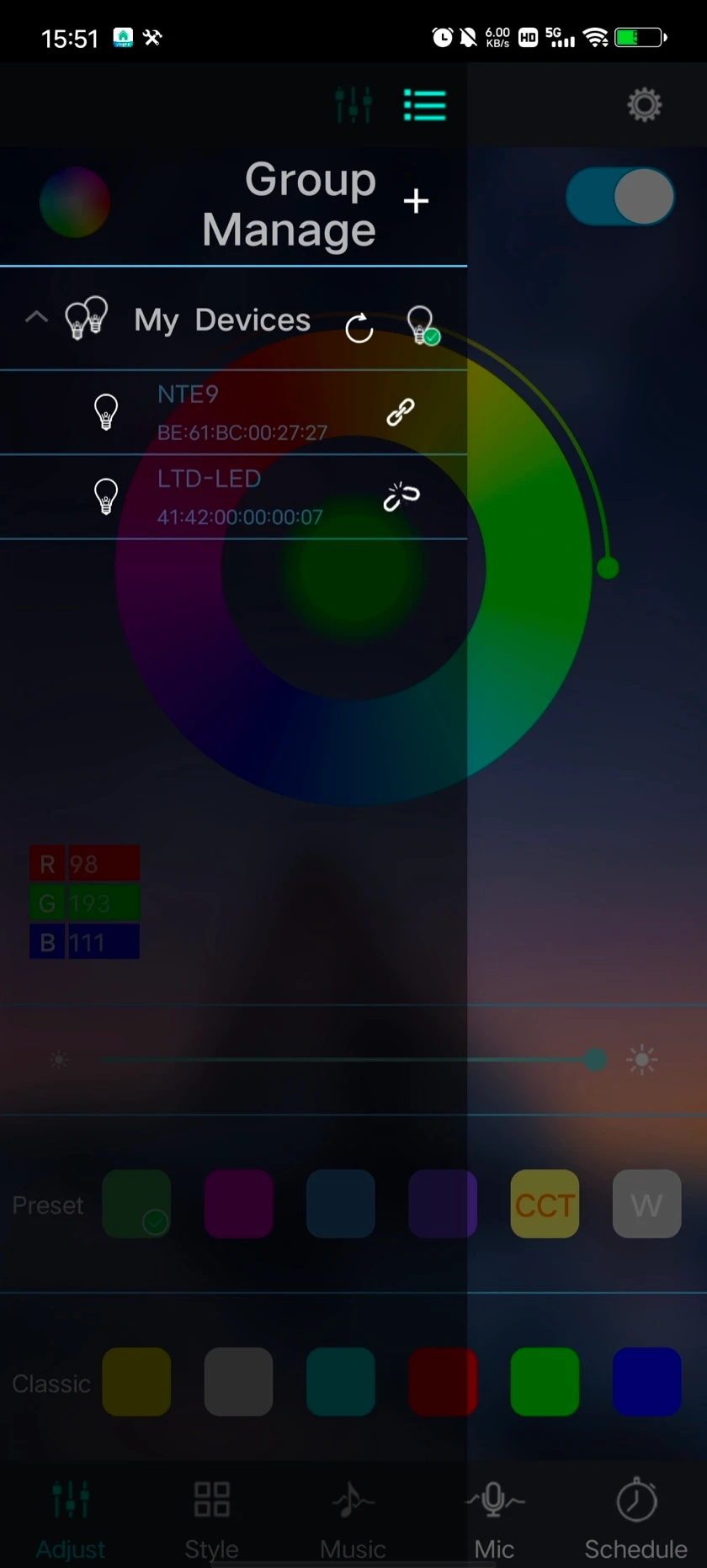
The list button at the top of the control screen opens My Devices. Each controller the app has found is listed by name with its Bluetooth address, and the link icon beside it shows whether it is connected. Discovered controllers are added to the list automatically; nothing has to be typed in.
- Power the light on and open the list. A controller that is powered, in range and built for this protocol appears within a few seconds.
- Tap the link icon beside a device to connect or disconnect it. The icon changes state once the link is made.
- Use Group Manage and the plus control to create a group, then assign devices to it. One colour or mode change then reaches every member.
An empty list with the light powered is the signature of the wrong app or a denied Bluetooth permission, not of a dead light. The common-problems table covers both.
Colour and brightness
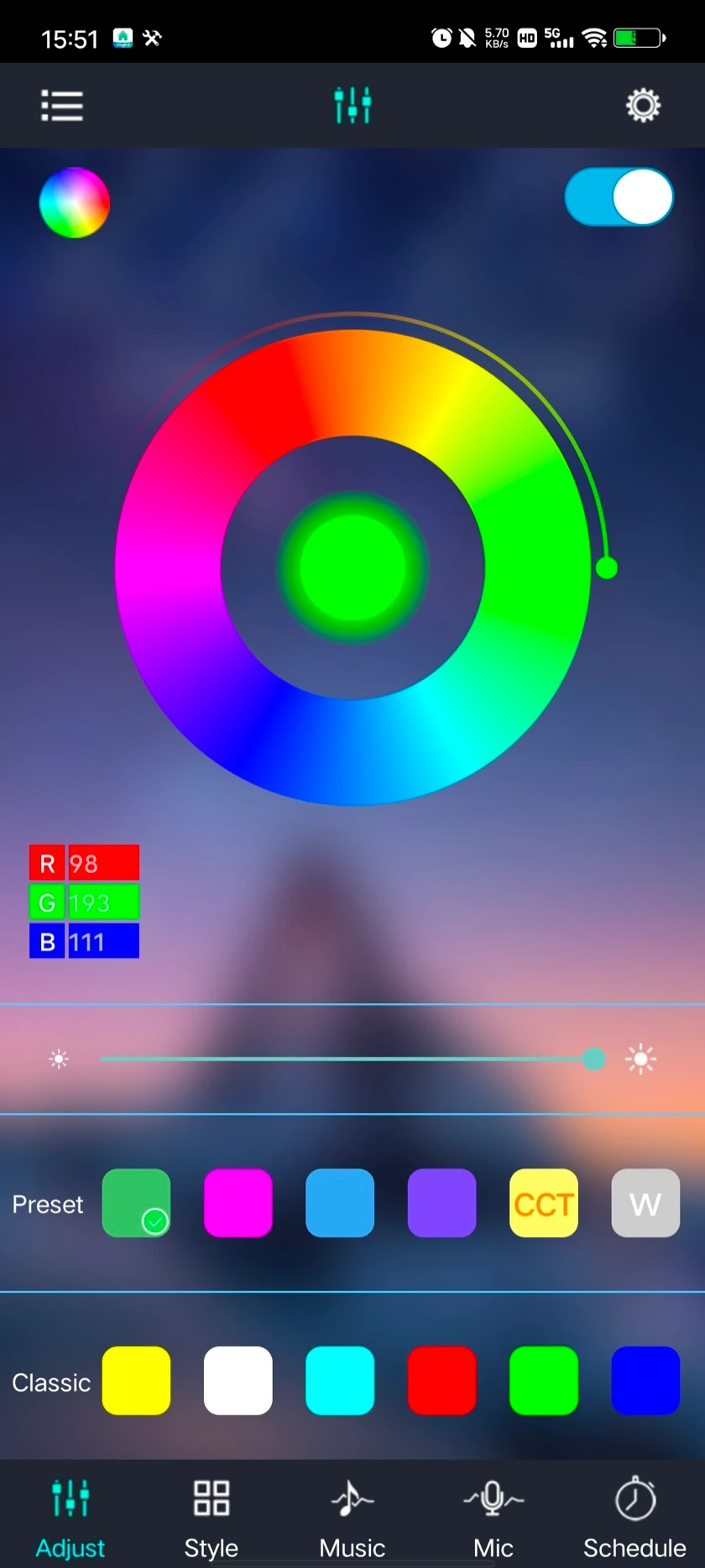
The Adjust tab holds the power switch, the colour ring, the numeric R, G and B values, the brightness slider and two rows of swatches. The Preset row includes CCT and W tiles for tunable-white and single-white outputs; the Classic row holds fixed yellow, white, cyan, red, green and blue.
- Switch the light on with the toggle at the top right of the Adjust tab.
- Choose the ring type with the small colour circle at the top left: coloured light for RGB, cool-and-warm light for a CCT strip, cold light for single white.
- Drag round the ring, or tap a swatch, to set the colour. The R, G and B values update as the marker moves.
- Tap the R, G or B value to enter a colour numerically. Two strips set to the same three numbers match; two set by eye rarely do.
- Move the brightness slider. On a tunable-white strip the ring sets the warm-to-cool ratio and the slider sets the output.
Dynamic modes
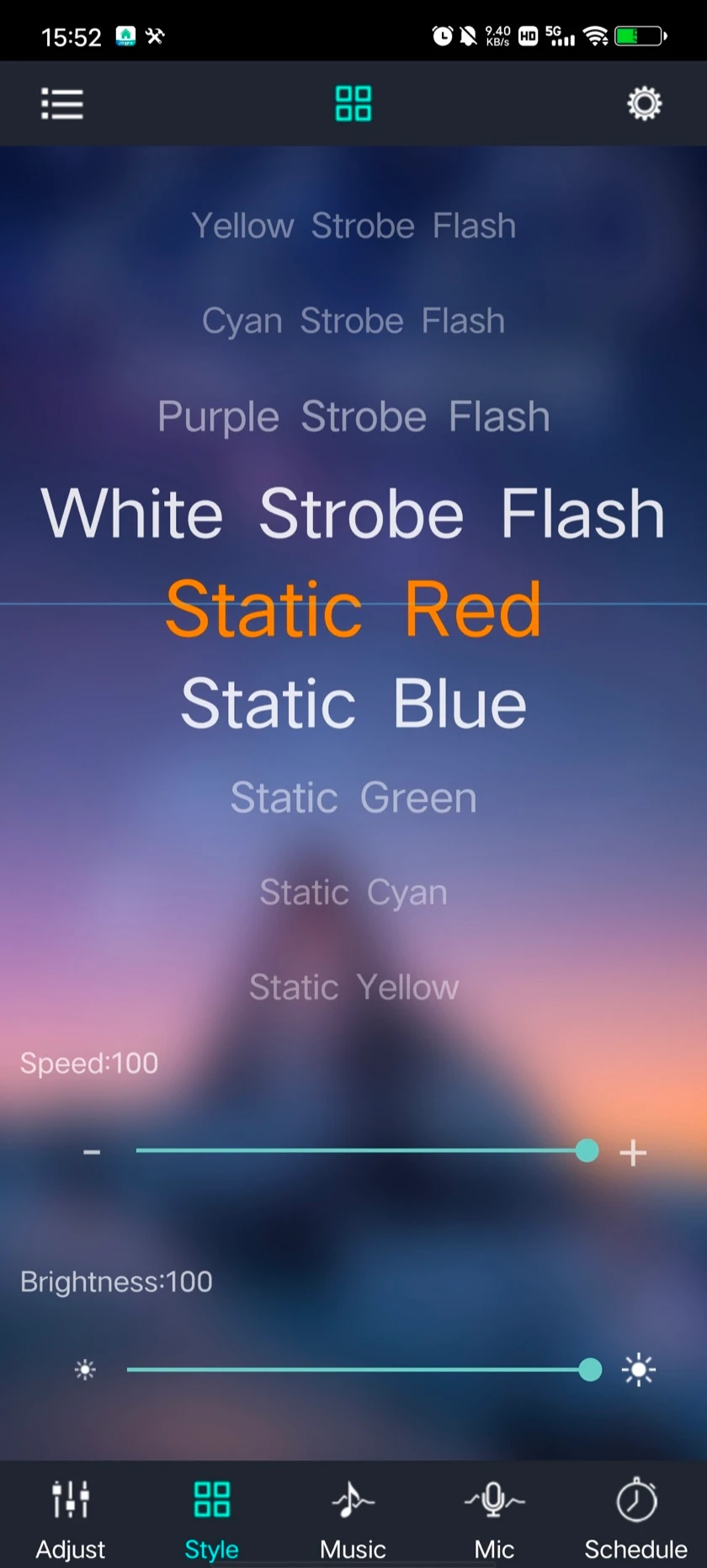
The Style tab lists the preset effects: static colours (Static Red, Static Blue, Static Green, Static Cyan, Static Yellow) and single-colour strobe patterns (White Strobe Flash, Purple Strobe Flash and the rest). Because every LED on the output changes together, the effects are changes over time rather than along the strip: fades, jumps and strobes, not chases.
- Open the Style tab and swipe the list vertically. The highlighted line is the active mode.
- Set Speed, shown as a value up to 100, for the rate of change of flash and fade effects.
- Set Brightness, also up to 100, for the effect's output.
Music
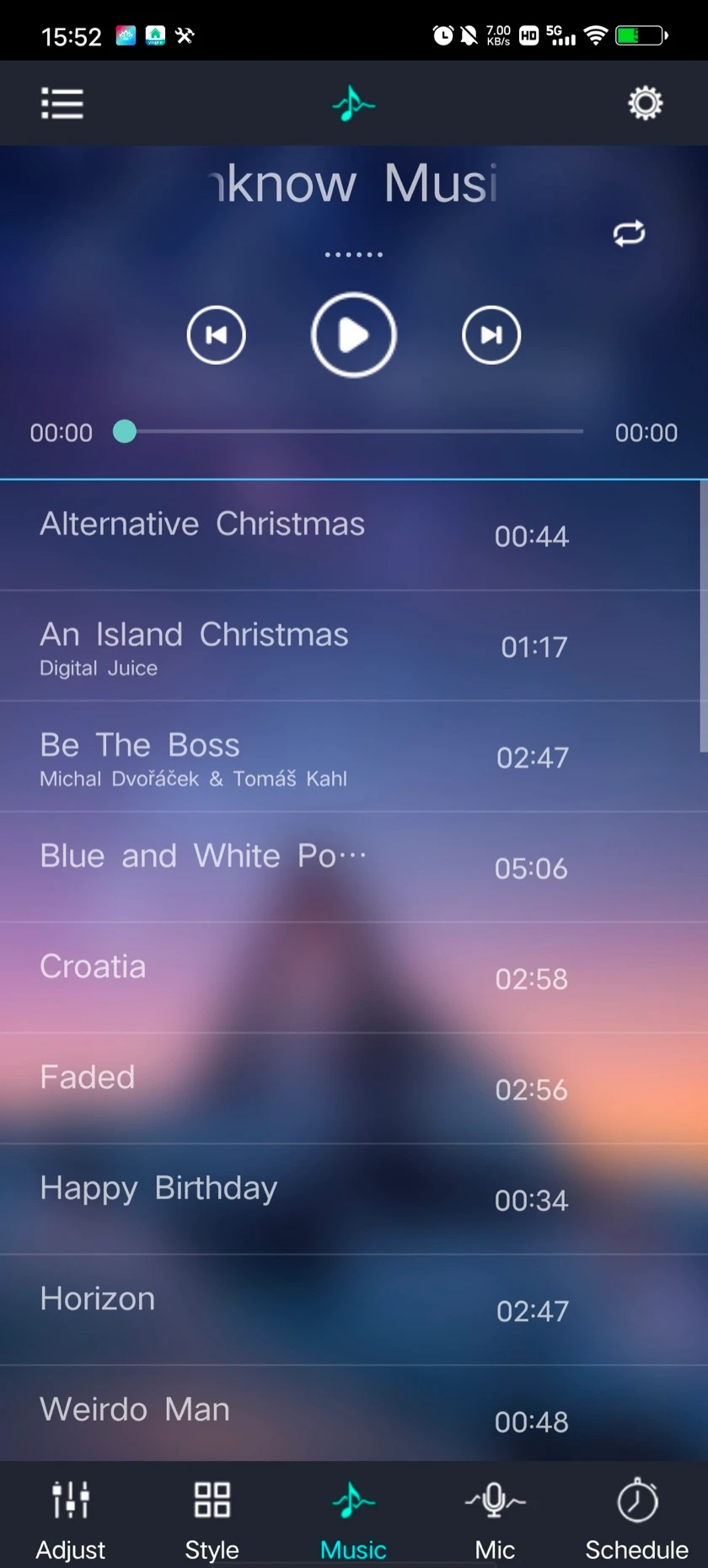
The Music tab plays audio files stored on the phone and drives the light from their rhythm. The phone does the listening, so the Bluetooth connection has to stay up and the app has to stay on the Music tab while a track plays.
- Open the Music tab and choose a track from the list.
- Use play or pause to control the current track.
- Use previous and next to change tracks.
- Choose a playback mode and follow the track on the progress bar.
Streaming apps and system audio are not captured; Phone MIC is the source for those. The three sound sources and what each is suited to are compared in music sync modes.
Phone microphone
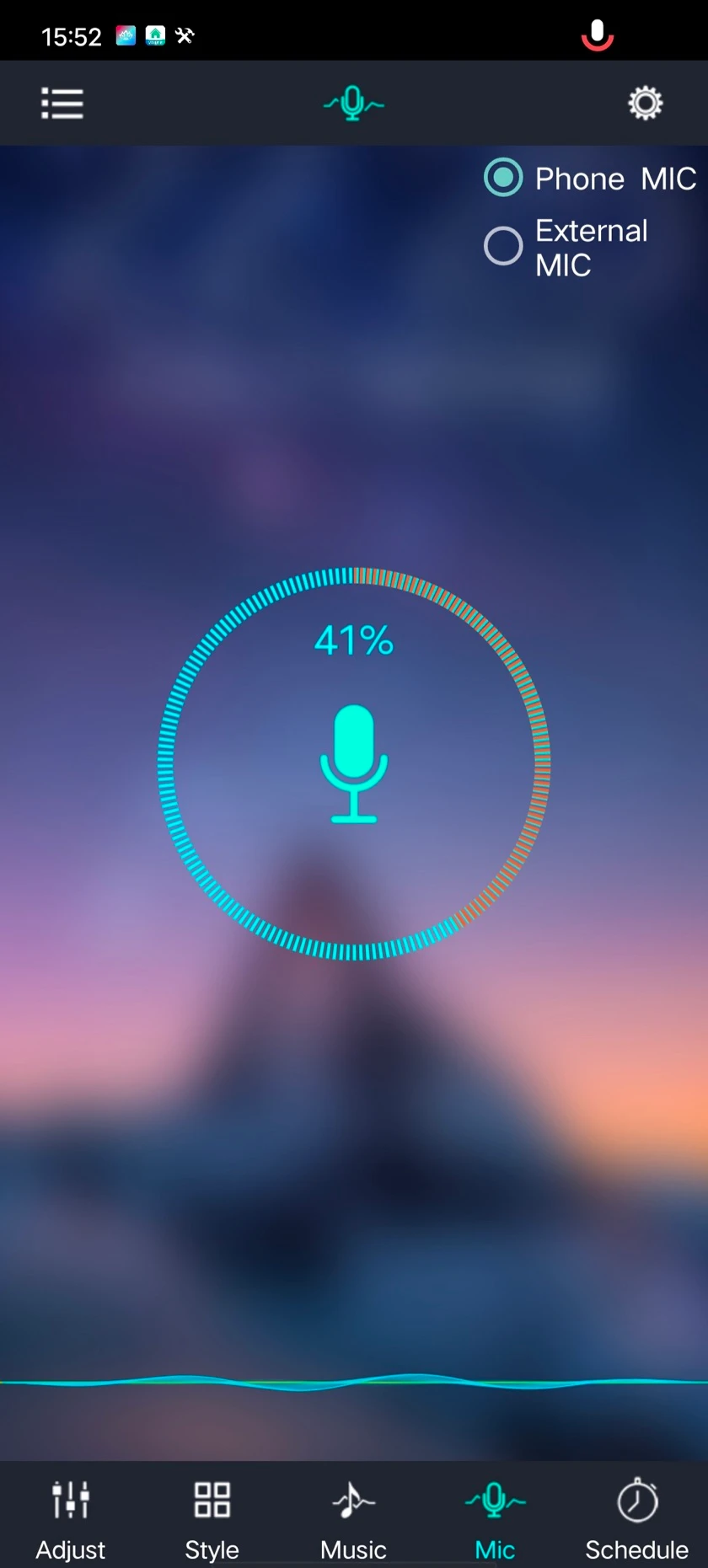
On the Mic tab, Phone MIC uses the phone's own microphone. The ring shows the current level as a percentage and the trace along the bottom shows the waveform; the light's rhythm follows that level.
- Open the Mic tab and select Phone MIC.
- Allow microphone access when the phone asks for it. The mode uses the phone's microphone and nothing else.
- Place the phone where the sound is: beside the speaker for music, on the table for a room. The level ring confirms what the phone is hearing.
Device microphone
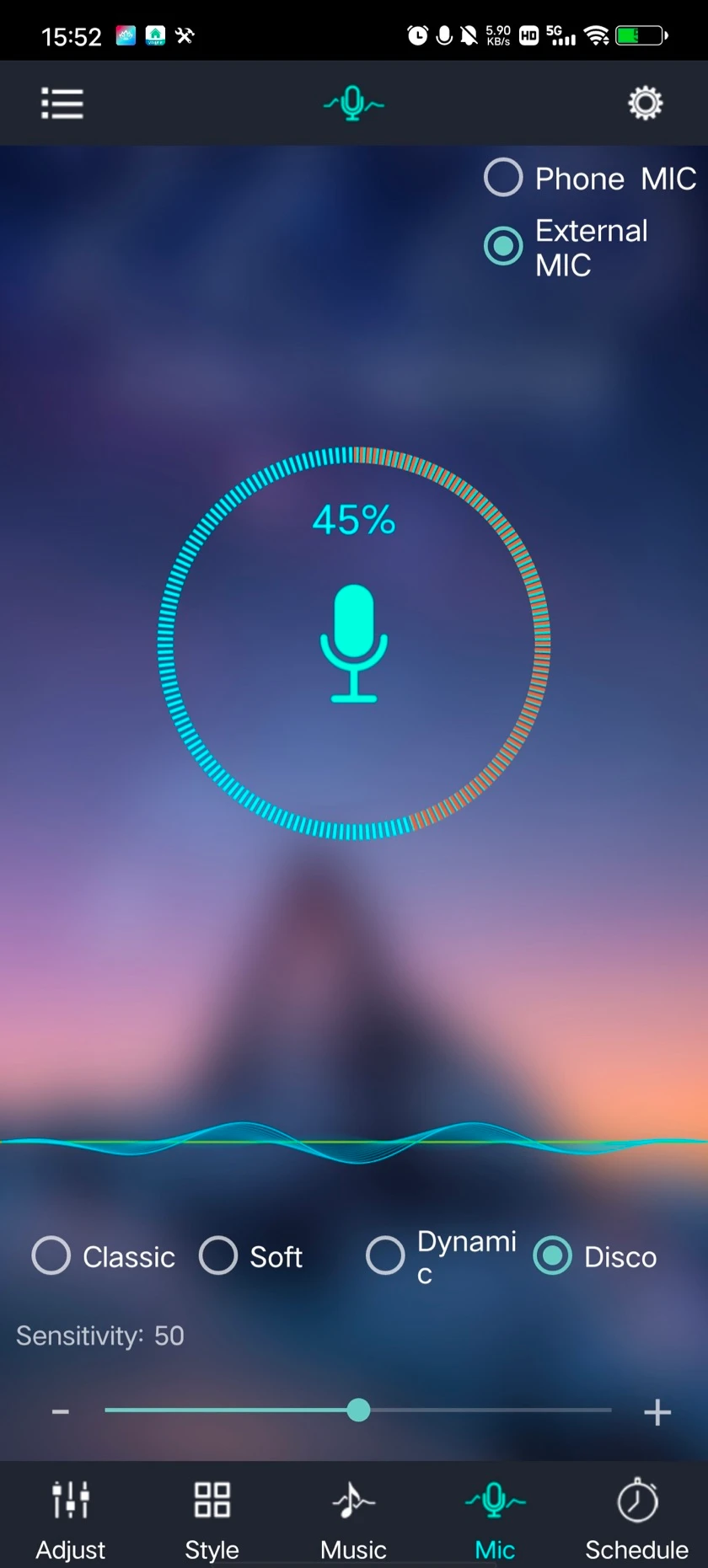
External MIC is the microphone built into the controller; the app calls it external because it sits outside the phone. Sound is picked up at the light, so the phone's position no longer matters. Four rhythm styles are offered, Classic, Soft, Dynamic and Disco, and Sensitivity sets how much sound is needed to drive a change.
- On the Mic tab, select External MIC. The option only responds on a controller that has a microphone fitted.
- Choose a rhythm style.
- Move the Sensitivity slider (the capture shows 50) until quiet passages leave the light steady and beats register.
- Select Phone MIC to return to phone-side pickup.
Scheduled on and off
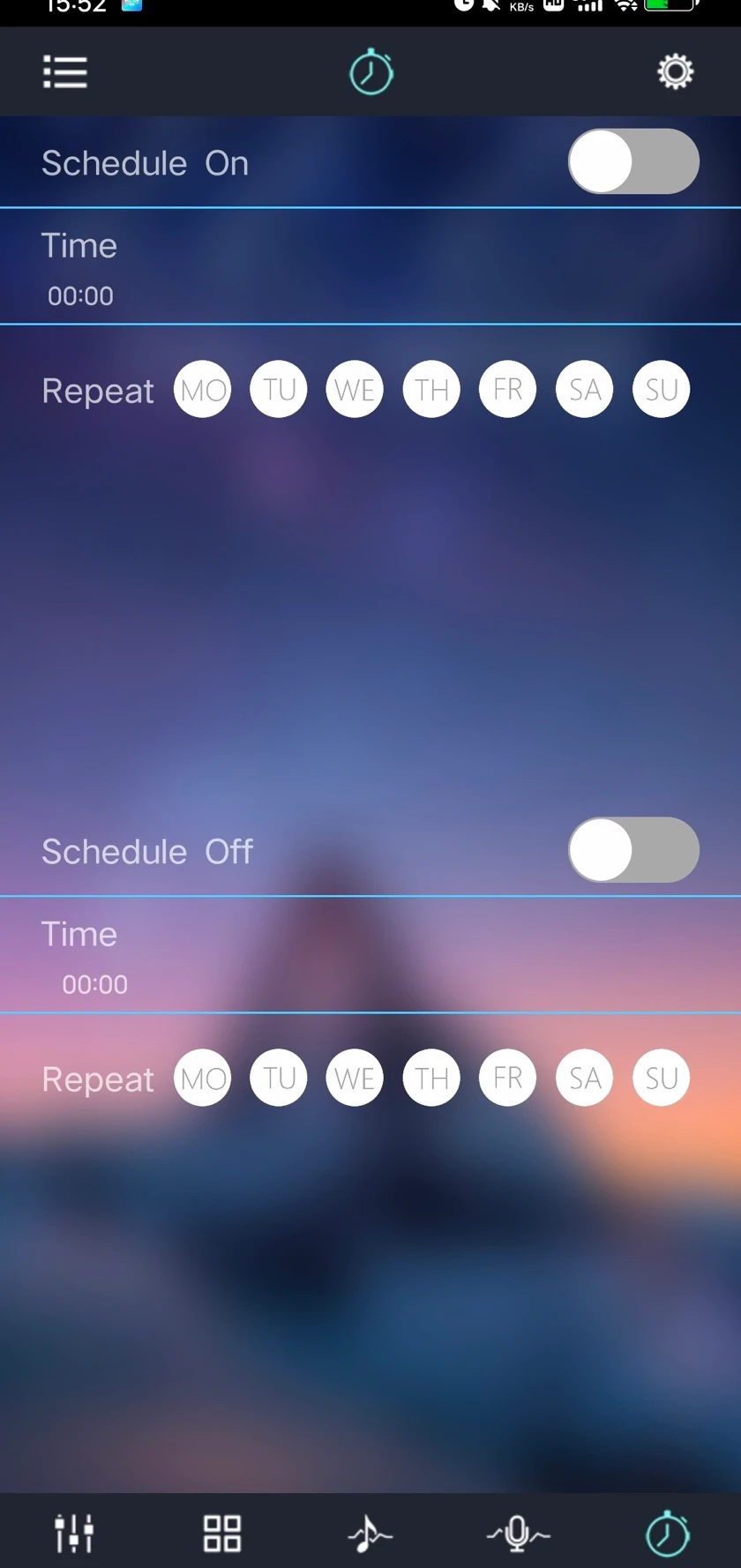
The Schedule tab holds two independent timers, Schedule On and Schedule Off, each with its own time and a Repeat row of weekdays from MO to SU.
- Open the Schedule tab and choose Schedule On or Schedule Off.
- Set the time.
- Tap the weekdays on which the timer should repeat. More than one can be selected.
- Enable the toggle for that timer. The other timer is set separately.
Settings
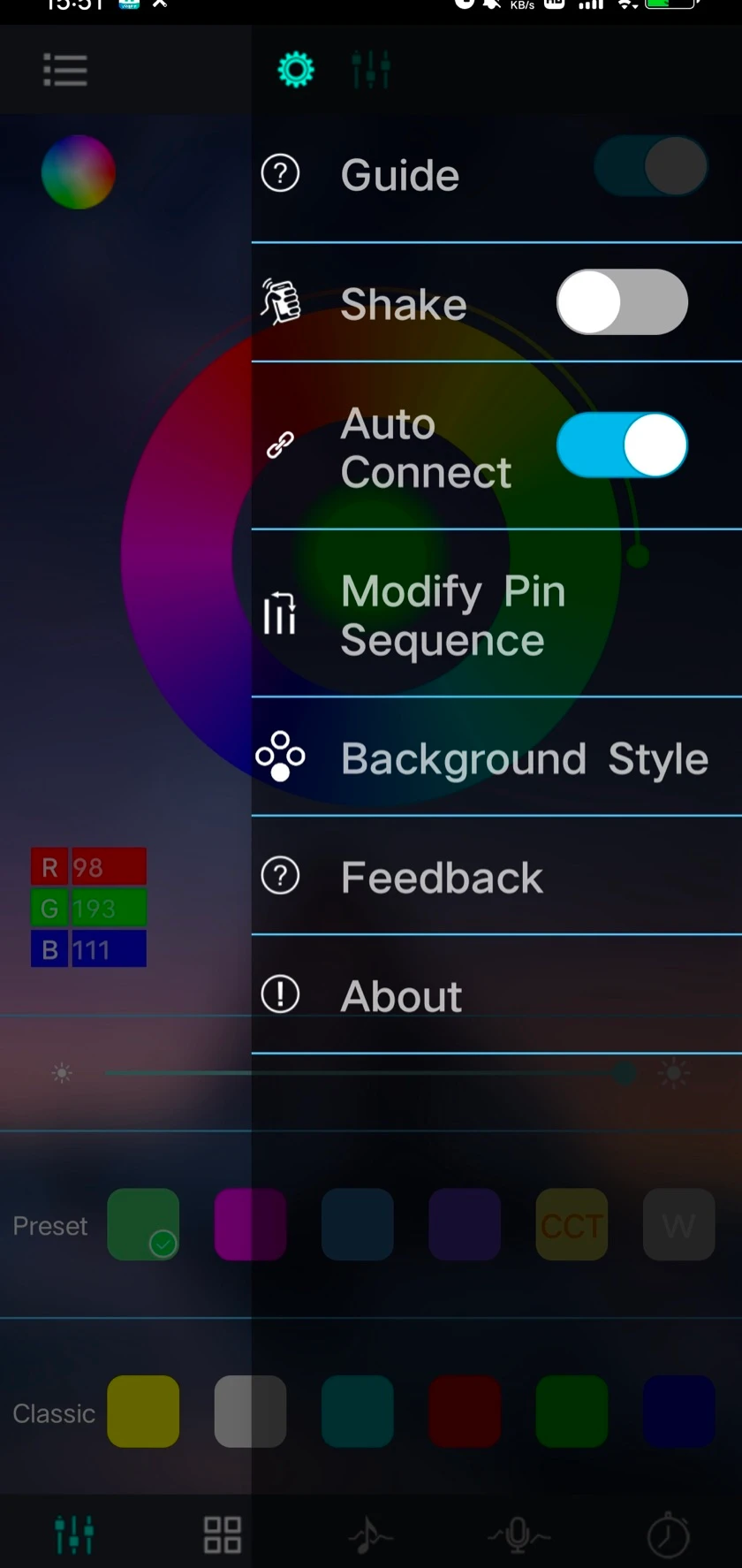
The gear icon at the top right opens the settings pop-up. It holds the two settings that decide whether a strip looks right, and they are easy to miss because they are not on the main control screen.
- Guide: toggles the in-app guide.
- Shake: change colour by shaking the phone.
- Auto Connect: connect automatically to controllers in the list.
- Modify Pin Sequence: remap red, green and blue to the strip's physical pins. The setting is stored on the controller.
- Pixels: the LED count used by running effects; listed when the connected controller uses it.
- Background Style: change the app background.
- Feedback, Instructions for Use: submit a problem or read the built-in manual.
- About: the app version.
Correcting the line sequence
Red comes out green when the strip and the controller disagree about which wire carries which colour. The pad order on RGB strips is not standardised, so a replacement strip or an extension from another source can arrive permuted. White looks correct whatever the order, which is why the fault hides. The test is to set pure red at full saturation: green or blue back means the order is swapped; nothing at all means that channel is not being driven and the connector is the problem.
- Connect to the light and confirm it responds to a brightness change. The change is saved to the controller, so a live connection is needed.
- Open the settings pop-up and choose Modify Pin Sequence.
- Assign red, green and blue to the three signal pins in the same left-to-right order as the header on the strip.
- Save. The setting survives closing the app and unplugging the light.
The full walkthrough, and the faults that look like channel order but are not, is in wrong colours and line sequence.
Common problems
| Symptom | Cause | Fix |
|---|---|---|
| Device list stays empty, no error | Wrong app for the controller, or Bluetooth / nearby-devices permission denied | Confirm the app in which app controls your light; grant the permission in the phone's settings for the app, not inside the app |
| Light appears, then vanishes; or connects and drops within seconds | Another phone that paired before has reclaimed it, or the phone is too far for the first handshake | Close the app on the other phone; pair within a metre or two, then move away |
| Connects and brightness works, but colours are wrong | Channel order: strip and controller disagree about which wire is which | Modify Pin Sequence in the settings pop-up; the setting is stored on the controller |
| Connects but nothing responds | The controller is not driving the strip | Check the connector between controller and light |
| Several identical names in the list | Multiple controllers in range | Power down all but the one wanted, then connect |
The permission location for each phone platform, the full failure table and the reset pattern are in pairing a light for the first time.
Privacy
Lotus Lantern asks for Bluetooth permission to scan for controllers (on Android 6 to 11 the system routes that request through the location permission; the app does not read your position) and for microphone permission only when Phone MIC is selected; the Google Play data-safety section states that no data is shared with third parties. The privacy policy covers the website, and the store listings carry the app's own data-safety details.
Questions about a specific light of ours? Contact us.
Sources: Google Play listing, Lotus Lantern; App Store listing, LotusLanternX.